Choosing the Right Stump Grinder for Your Property
Selecting a stump grinder is not a one‑size‑fits‑all decision. Machine size, power, and mobility directly affect how quickly a stump is removed, how deep the grinder can reach, and whether the surrounding property remains intact. Understanding the differences between grinder classes helps property owners and contractors match equipment to the actual job requirements.
Walk‑Behind Grinders
Walk‑behind grinders are the most common machines for residential properties. These units typically weigh between 500 and 1,500 pounds and are maneuvered by hand. Their cutting wheels range from 10 to 25 inches in diameter, with cutting depths of 8 to 12 inches below grade.
For a single stump in a fenced backyard or near a driveway, a walk‑behind machine offers sufficient power while keeping access simple. However, these grinders struggle with oversized stumps, extensive root systems, or hardwoods like oak and pecan that require sustained torque. Their smaller cutting wheels also mean more time on site when removing multiple stumps.
Track‑Mounted Grinders
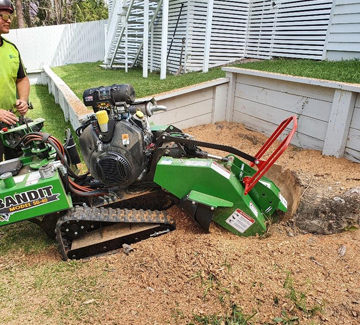
Track‑mounted grinders, such as the Bandit 2550, are purpose‑built for production work and larger projects. The tracks distribute machine weight evenly, preventing turf damage and allowing operation on slopes where wheeled units would lose traction. Cutting depths often exceed 12 inches, and the cutting wheel diameter can reach 30 inches or more.
These machines excel on commercial properties, golf courses, and tree removal sites where efficiency matters. A track grinder can reduce a 30‑inch oak stump to wood chips in minutes rather than hours. The trade‑off is transport: a track machine requires a trailer and a truck capable of hauling several thousand pounds.
Tow‑Behind and PTO‑Driven Grinders
Tow-behind grinders are designed for contractors who frequently move between jobs. They mount on a single axle and attach to a vehicle hitch. Once on site, they are detached and operated remotely. These machines sit between walk‑behinds and track units in both power and price.
PTO‑driven grinders attach to a tractor’s three‑point hitch and draw power from the tractor’s engine. They are common on farms and rural properties where a tractor is already present. Both options work well for properties with open access, but lack the precision of self‑propelled units in confined spaces.
Matching Equipment to Property Needs
Residential properties typically require a grinder capable of cutting 8 to 12 inches below grade and handling stumps up to 24 inches in diameter. Walk‑behind machines satisfy most single‑stump jobs when access is narrow.
Commercial projects, tree company support, and large residential lots demand different capabilities. Multiple stumps, root grinding, and stumps left from large removals require a machine with higher horsepower, hydraulic drive, and the ability to cut deep enough to allow replanting or hardscaping. Track‑mounted grinders deliver consistent depth and faster cleanup.
Final Considerations
Equipment choice affects more than speed. A grinder that lacks power leaves roots that sprout new growth. A machine that is too large for the access point risks damaging fences, sprinklers, or landscape features. Property owners and contractors should evaluate stump count, stump size, site access, and the intended use of the cleared area before selecting or hiring a grinder. The right machine leaves the site level usable and free of lingering root problems.